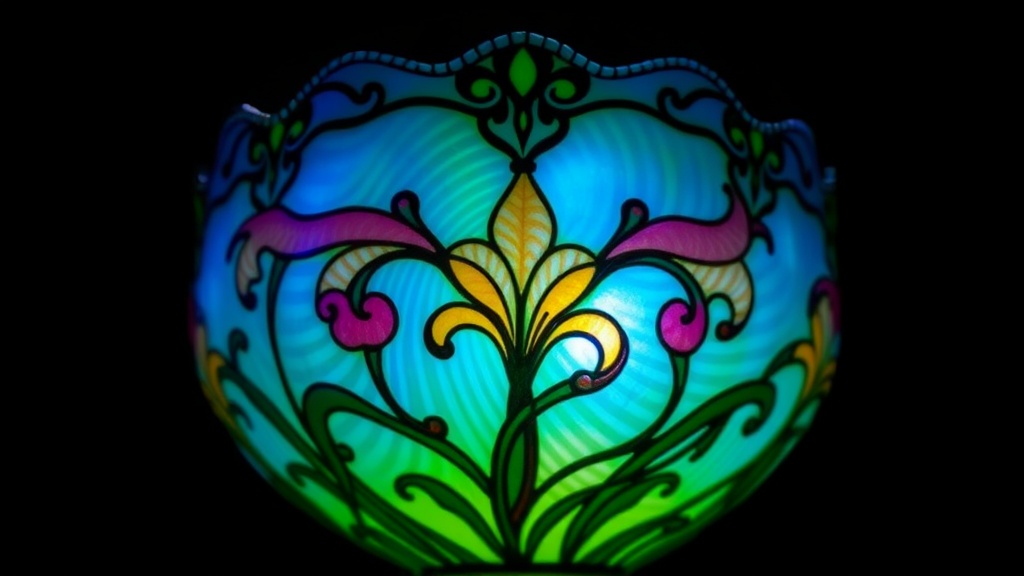
Tracing the Evolution of Art Nouveau Glasswork

Have you ever wondered why certain pieces of vintage glass seem to glow with an organic, almost living energy? This post examines the specific technical shifts and stylistic hallmarks that defined Art Nouveau glasswork between roughly 1890 and 1910. We'll look at the transition from traditional industrial glass to the highly decorative, nature-inspired aesthetics of the Belle Époque, focusing on the chemists and glassmakers who changed the way we view light and color.
What Defines the Art Nouveau Glass Aesthetic?
Art Nouveau glass is defined by its rejection of rigid, geometric forms in favor of sinuous, asymmetrical lines inspired by organic nature. Instead of the straight edges found in later Art Deco pieces, these objects feature "whiplash" curves—a hallmark of the era. Designers wanted to mimic the way a vine curls or a lily bends under its own weight.
The movement was a reaction against the heavy, dark aesthetics of the Victorian era. Collectors often look for certain "tells" in the glass itself. You'll notice a preference for iridescent finishes, subtle color gradations, and textures that feel tactile rather than perfectly smooth. It isn't just about looks; it's about how the light interacts with the surface. If a piece looks like it has a thin film of oil on it—a technique often called iridescence—you're likely looking at a classic piece of the era.
The movement relied heavily on:
- Asymmetry: Unlike the perfect symmetry of the Renaissance, Art Nouveau embraced the "perfect imperfection" of nature.
- Organic Motifs: Think dragonflies, lilies, poppies, and winding stems.
- Fluidity: The glass often looks like it's still in motion.
One of the most famous names in this niche is Émile Gallé. He wasn't just a maker; he was a scientist of sorts. His work often involved complex layering techniques that allowed light to penetrate deep into the glass. It's a far cry from the mass-produced glass you might find in a modern souvenir shop. If you're interested in how to handle these delicate pieces once you own them, you might want to check out my guide on protecting your precious past.
Who Were the Key Makers of Art Nouveau Glass?
The most significant figures in this movement were often more than just glassblowers; they were artists who treated glass as a canvas for fine art. While many names are often lumped together, the distinctions between their styles are quite sharp when you know what to look for.
Émile Gallé remains the titan of the movement. Based in Nancy, France, his work often leaned into the "botanical" side of Art Nouveau. He used techniques like cameo glass—where layers of different colors are etched away to reveal a design underneath—to create incredibly detailed scenes. His work is frequently found in museum collections, including the Musée de Verre de Nancy.
Then there is René Lalique. While he is perhaps most famous for his jewelry, his glasswork is legendary. His style was often a bit more sculptural and could be more "decadent" than Gallé's. If Gallé is the poet of the natural world, Lalique is the architect of the dreamlike and the surreal. His pieces often feel more structured, even when they use those famous flowing lines.
It's worth noting that these makers weren't just making vases. They were creating an entire lifestyle. This included everything from perfume bottles to heavy, decorative lamp bases. The level of craftsmanship required to achieve the "cameo" effect—where you etch through one color to show another—is immense. One wrong move with the acid or the tool, and the entire piece is ruined. It's high-stakes art.
| Maker | Primary Style | Signature Technique |
|---|---|---|
| Émile Gallé | Botanical/Naturalistic | Cameo glass & layered etching |
| René Lalique | Sculptural/Decadent | Molded glass & frosted finishes |
| Daum Frères | Color-focused | Acid etching & vibrant color play |
How Can You Identify Authentic Art Nouveau Glass?
Authenticity is determined by examining the weight, the way the light refracts through the material, and the presence of specific manufacturing marks or signatures.
First, look at the signature. Authentic pieces from the era often have etched or acid-engraved signatures. However, be careful—forgers have been at this for a century. A signature that looks too "perfect" or sits on top of the surface rather than being integrated into the glass can be a red flag. Many collectors use high-powered magnification to look at the depth of the engraving. If the signature looks like it was printed on, rather than etched into the glass, proceed with caution.
The second factor is the color. Art Nouveau glass often uses "subtle" colors—think muted ambers, soft greens, and dusky violets. If you see a piece that is incredibly bright, neon, or has a "flat" color that doesn't react to light, it might be a later reproduction. The goal of the original makers was to capture the ephemeral quality of light. A piece that looks "dead" under a flashlight is rarely a high-end Art Nouveau original.
The third factor is the texture. Many Art Nouveau pieces utilize "frosted" or "acid-etched" surfaces. This isn't just for aesthetics; it's part of the design. If you're looking at a piece that feels too smooth or lacks any textural character, it might be a modern imitation. The interplay between the smooth, polished parts and the matte, etched parts is what creates that "organic" feel.
One thing to keep in mind: many of these pieces were created during a time when chemical-based coloring was being perfected. The colors aren't just surface-level; they are often part of the glass melt itself. This means the color should feel deep and integrated, not like a thin layer of paint. If you can scratch the color off with a fingernail (don't actually do this!), it's a fake. The color is part of the glass's soul.
When you are out hunting for these pieces, you'll often find them in estate sales or specialized auctions. It's a much more technical hunt than looking for Mid-Century Modern decor. You have to look at the physics of the object. How does the light travel through it? Does the weight feel right for the size? Does the etching feel like it has depth?
If you find yourself transitioning from collecting jewelry to collecting fine art glass, you'll notice a similar need for technical scrutiny. Much like identifying authentic Art Deco gemstones, glass collecting requires an eye for the "unseen" qualities of the material. It's about the light, the chemistry, and the history.
The evolution of this glasswork wasn't just a change in fashion. It was a revolution in how humans perceived the relationship between the industrial world and the natural world. These pieces were a way to bring the "wild" back into the parlor, even as the world became increasingly mechanized. It's a beautiful, fragile piece of history that deserves a very careful hand.