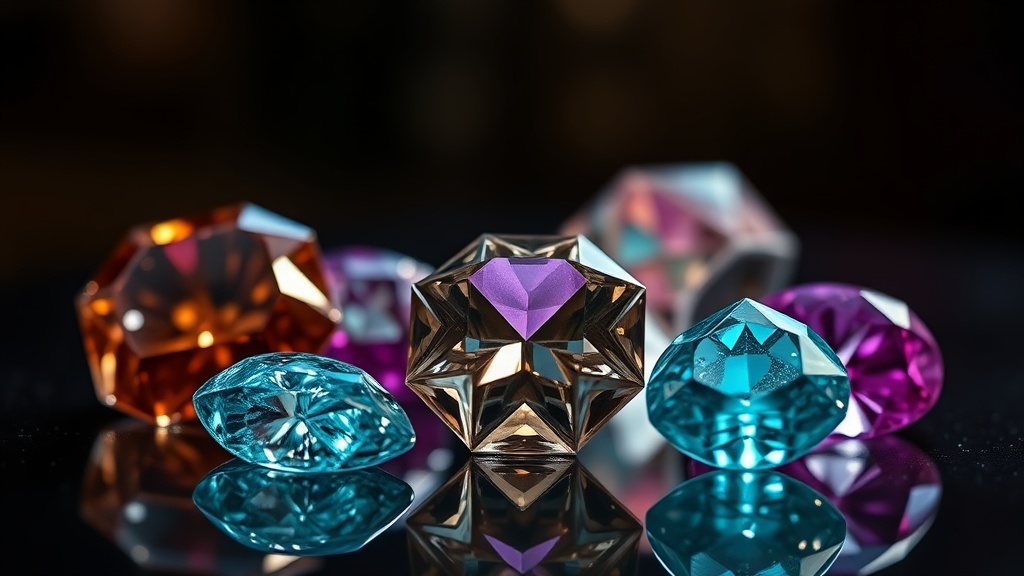
Identifying Authentic Art Deco Gemstones

A collector recently sat in a brightly lit auction house, staring at a platinum ring that looked far too perfect to be true. The stone was a vivid, saturated blue, but it lacked the slight structural imperfections one expects from a genuine sapphire of the 1920s. It was a high-quality synthetic, and without a keen eye, the collector would have paid a premium for a clever imitation. This post looks at the specific hallmarks of genuine Art Deco era gemstones, focusing on how to distinguish natural stones from the synthetics and glass imitations that frequently surface in the vintage market.
The Art Deco period (roughly 1920–1935) was a time of incredible geometric precision and a fascination with exotic, high-contrast colors. During this era, jewelers weren't just using diamonds; they were experimenting with emerald cuts, baguettes, and cabochons in stones like sapphires, rubies, and jade. Understanding these stones requires more than just a magnifying glass—it requires an understanding of the era's specific cutting styles and the technological limitations of the time.
How Can You Tell if an Art Deco Gemstone is Real?
The most effective way to identify an authentic Art Deco gemstone is to examine the cut, the inclusions, and the light refraction under a jeweler's loupe. Genuine vintage stones often possess "character"—tiny internal flaws or natural characteristics that modern lab-grown or synthetic stones lack. If a stone looks absolutely perfect, almost too sterile, it might be a modern synthetic or a high-quality glass imitation.
First, look at the edges of the facets. Art-deco era cutting was precise but often lacked the laser-perfect sharpness of 21st-century machines. You might see slight irregularities in the pavilion or the crown. These aren't "damage"; they are signs of hand-finished craftsmanship. If you see a stone with perfectly uniform, machine-cut facets and zero internal inclusions, be skeptical. A gemologist would tell you that a total absence of inclusions in a natural stone is a red flag.
Second, consider the color. Art Deco jewelry often utilized "saturated" colors, but these were natural. A synthetic sapphire, for example, often has a color that is too "uniform" or looks slightly "electric" under certain lighting. Natural stones have subtle shifts in tone and saturation that react to the environment. If the color feels static and artificial, it's a sign of a lab-created stone.
One thing to keep in mind: the era also saw a rise in high-quality glass and paste. While these aren't "real" gemstones, they were legitimate part of the jewelry landscape of the time. However, if you are buying an investment piece, you want to ensure you aren't paying sapphire prices for high-end glass.
Common Substitutions to Watch For
During the 1920s and 30s, several "imitations" were common. It's important to distinguish between a "period-correct" stone and a "fake" stone. A glass stone in an Art Deco setting is a piece of history; a synthetic sapphire in a "vintage-style" ring is a modern imitation.
- Paste: High-quality leaded glass used to mimic diamonds or precious stones. It has a certain "glow" but lacks the refractive brilliance of a real diamond.
- Synthetic Spinel: Often used to mimic rubies. While natural spinel exists, many vintage pieces used synthetic versions that are hard to distinguish without testing.
- Glass Stones: Frequently used in costume jewelry of the era. These are often colored to look like emeralds or sapphires.
What Are the Characteristics of Art Deco Cuts?
Art Deco gemstones are defined by geometric shapes and precision cutting that emphasizes light and line. Unlike the softer, rounded cuts of the Edwardian era, Art Deco jewelry favors sharp angles and straight edges.
If you are looking at a stone, check the geometry. The era was obsessed with the "machine age" aesthetic. This means you'll see a lot of:
- Baguette Cuts: Long, rectangular stones that provide a sleek, architectural look.
- Emerald Cuts: Step-cuts that create a "hall of mirrors" effect.
- Calibré Cuts: Small, custom-cut stones that fit perfectly into the geometric outlines of a setting.
The way these stones are set is just as important as the cut itself. In a genuine piece, the stones (especially the smaller accent stones) will be cut to fit the specific geometry of the metalwork. If the stones look like they were "dropped in" or don't quite fit the architectural lines of the platinum or white gold, you might be looking at a modern reproduction or a lower-quality piece. This precision is a hallmark of the era's high-end jewelry design.
It's also worth noting that many Art Deco pieces used "calibré" stones to create a seamless look. These are tiny, custom-shaped stones that follow the curves or angles of the metal. If the stones seem slightly mismatched or poorly fitted, it's a sign that the piece may not be an authentic high-end vintage item.
Is the Stone Natural or Lab-Created?
Determating if a stone is natural or lab-created usually requires specialized equipment, but there are a few manual tests you can perform to narrow down the possibilities.
The first thing to check is the "inclusion profile." Natural gemstones, like rubies or emeralds, almost always have inclusions—tiny bubbles, cracks, or mineral deposits. In the gemology world, these are often called "birthmarks." Synthetic stones are grown in controlled environments, meaning they are often "too clean." If you see a stone that is perfectly transparent with no internal structure whatsoever, it is highly likely to be a synthetic or a high-quality glass.
Another way to check is through the weight and density. While you can't weigh a stone in your hand, the "feel" of the jewelry can be a giveaway. Synthetic stones often have different specific gravities than natural ones. For instance, a synthetic sapphire might feel "lighter" or "lighter-looking" than a natural one of the same size. This is a subtle distinction, but experienced collectors often notice it.
| Feature | Natural Art Deco Stone | Synthetic/Lab-Created Stone |
|---|---|---|
| Inclusions | Visible, irregular, and natural. | None, or very uniform/repetitive. |
| Color Tone | Variations in saturation and depth. | Extremely uniform and "flat." |
| Cut Precision | Hand-finished, slight irregularities. | Perfectly symmetrical, machine-like. |
| Refraction | Natural light play and depth. | Can look "plastic" or overly bright. |
One thing to remember: many people mistake "vintage-style" for "vintage." A modern ring made to look like it's from 1925 will often use lab-grown stones. These stones are beautiful, but they lack the historical weight of a stone that was actually cut and polished a century ago. If you are buying for investment, always ask for a certificate or a detailed description of the stone'ality.
If you're worried about the longevity of your collection, you should also look into proper care for vintage jewelry. A natural stone with inclusions might be more delicate than a synthetic one, and understanding that helps you maintain the piece properly.
The truth is, a little bit of knowledge goes a long way in the vintage market. You don't need a PhD in gemology, but you do need to know what to look for. Whether it's the way the light hits a baguette cut or the presence of a tiny internal fracture, these details tell the story of the piece. A piece of jewelry is more than just a stone in a metal setting—it's a piece of history. And history, by its very nature, is rarely perfect.
Steps
- 1
Examine the Cut and Symmetry
- 2
Test Light Refraction
- 3
Check for Natural Inclusions
- 4
Verify Setting Compatibility