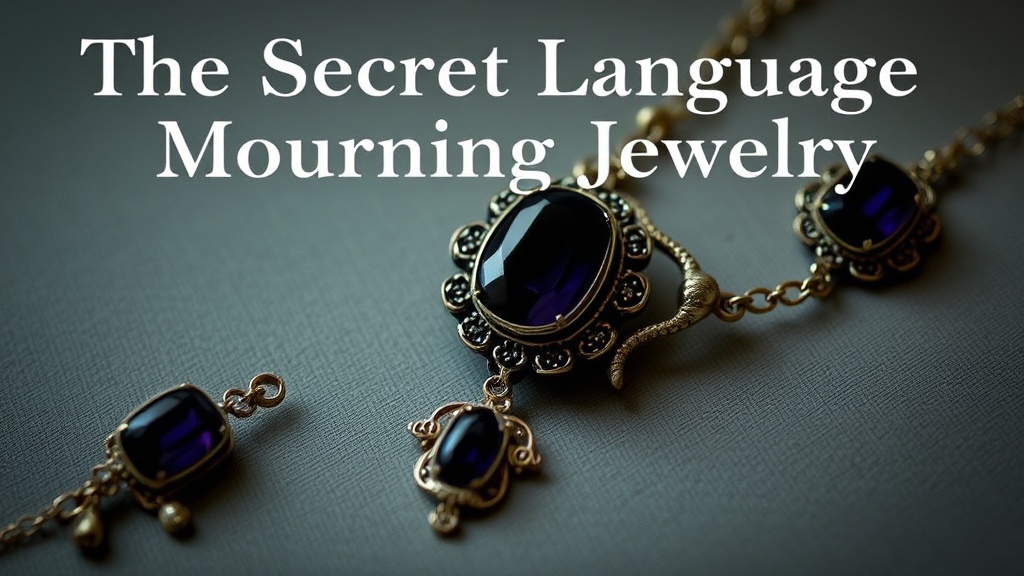
The Secret Language of Victorian Mourning Jewelry

In this post, you'll learn to identify the specific materials, symbols, and social protocols used in Victorian mourning jewelry. We'll look at how to distinguish between different types of mourning pieces—from jet and hair jewelry to heavy gold—and what these items actually communicated about the wearer's social status and grief.
Victorian mourning jewelry isn't just "old jewelry." It's a highly codified system of visual communication. During the 19th century, particularly during the reign of Queen Victoria, jewelry served as a public declaration of a person's state of bereavement. It told the world exactly who had died and how much the wearer was expected to grieve.
What are the most common materials in Victorian mourning jewelry?
The most common materials used in Victorian mourning jewelry are jet, black enamel, onyx, and human hair. While many people assume all black jewelry is simply "dark," the material used often dictated the level of formality and the specific stage of the mourning period.
Jet is perhaps the most iconic material. This is a fossilized form of coal, technically a way of saying it's a type of lignite. It's lightweight, which was practical for long-term wear, but it's also quite fragile. If you're holding a piece of Whitby Jet, you're holding a piece of English history. The Whitby Jet industry was massive during this era, and high-quality pieces are still highly sought after by collectors today.
Then there's the more visceral side of the Victorian era: hair jewelry. It's easy to feel a bit squeamish about it now, but back then, incorporating a loved one's hair into a brooch or a ring was considered a deeply respectful way to keep their essence close. It wasn't just a memento; it was a physical connection.
- Jet: Fossilized coal, often polished to a high shine.
- Onyx: A hard, black stone used for a more subtle, "semi-mourning" look.
- Black Enamel: Used frequently on gold or silver-gilt settings.
- Human Hair: Woven into intricate patterns, often encased in glass or set in gold.
- Bog Oak: A dark, dense wood that mimics the look of stone or jet.
I've often seen collectors mistake dark glass for jet. A quick way to tell? Jet is much lighter. If it feels heavy like a rock, it's probably glass or onyx. If it's surprisingly light, it's likely jet.
How do you identify the different stages of mourning?
Jewelry changes based on the stage of mourning, moving from "deep mourning" to "half-mourning." This transition was strictly regulated by social etiquette. You didn't just stop wearing black; you slowly reintroduced color and lighter materials as time passed.
The first stage is Deep Mourning. This is the most severe period, usually following the death of a spouse or parent. During this time, the jewelry was almost exclusively matte black—think unpolished jet or black crepe. There was no shine allowed. It was a visual signal that the wearer was in the thick of their grief.
As the years passed, the wearer moved into Second Mourning and eventually Half-Mourning. This is where the "secret language" becomes visible. In Half-Mourning, the strict black rules relaxed. You might see the introduction of:
- Purple or lilac colors
- Grey tones
- White or cream pearls
- Gold settings (previously hidden by black enamel)
It's a fascinating way to track a person's life through their jewelry box. A woman's jewelry collection could essentially serve as a timeline of her losses and her recovery. It's not just decoration; it's a biography.
The Symbolism of Victorian Jewelry
Every single element in a mourning piece had a meaning. If you see a skull, it's not just a "cool" design. It's a memento mori—a reminder of death. But the Victorians used a much wider range of symbols to convey different nuances of loss.
A common one is the weeping willow. This symbol represents the sorrow of the bereaved and is frequently found in engravings on rings or even on the way hair is arranged in a brooch. Another is the urn, which signifies the end of life and the vessel of memory.
The presence of certain stones also mattered. While jet was the standard, some collectors find pieces featuring black tourmaline or even dark garnets. These were often used to signify a more personal, perhaps less "public" type of grief. It's worth noting that the more expensive the materials, the higher the social standing of the deceased. A gold-set hair brooch tells a very different story than a simple jet ring.
| Feature | Deep Mourning | Half-Mourning |
|---|---|---|
| Primary Color | Matte Black | Purple, Grey, or White |
| Typical Material | Unpolished Jet, Black Crepe | Pearls, Gold, Colored Gemstones |
| Visual Tone | Somber and Heavy | Subtle and Transitioning |
| Social Signal | Acute Grief/Recent Loss | Slowly Returning to Society |
How much is Victorian mourning jewelry worth?
The value of Victorian mourning jewelry depends heavily on the material, the craftsmanship, and the provenance. While a simple jet ring might be affordable, a high-end piece of Whitby Jet or an intricate gold-set hair piece can command a significant premium.
When looking at value, you have to consider the "authenticity" of the piece. There is a massive market for Victorian-style jewelry made in the 20th century. If you're looking at a piece of "mourning jewelry" that feels too perfect or has modern machine-cut edges, it might be a later revival piece. True Victorian pieces often show the hallmarks of hand-craftsmanship—slight irregularities that tell you a human made it.
Here’s the thing: a piece of hair jewelry is often valued more for the sentiment and the "story" than just the raw materials. Collectors love the human element. A piece that can be traced back to a specific era or even a specific historical context is worth much more than a generic black stone ring.
If you are hunting for these pieces, look for hallmarks. Even in the 19th century, makers were leaving marks. These marks can help you identify the quality of the metal and the maker, which directly impacts the price. Don't just look at the stone; look at the setting. A gold setting with black enamel is a much higher-tier item than a simple silver-plated one.
I often see people overlook the value of the hair itself. In the world of high-end collecting, "hair-work" is a specific niche. The more complex the weave, the higher the value. It's a skill that has almost vanished from modern jewelry making.
If you're looking for more technical details on gemstone identification, the Gemological Institute of America (GIA) is a great resource for learning how to distinguish between real jet and various imitations. It's a vital skill for any serious collector of the era.
One thing to keep in mind: the "look" of mourning jewelry can be deceptive. Some pieces are designed to look like much more expensive stones. A high-quality piece of black glass can look identical to jet in a photograph, but once you hold it, the weight and the temperature tell the real story. Glass stays cool, but it doesn't have that specific, organic density that jet possesses. It's a subtle difference, but for a collector, it's everything.
The more you study these pieces, the more you realize they aren't just accessories. They are heavy, physical manifestations of a culture that didn't hide its death, but rather, wore its grief openly. It's a stark contrast to how we handle loss today, which is why these pieces feel so much more intense when you see them in person.