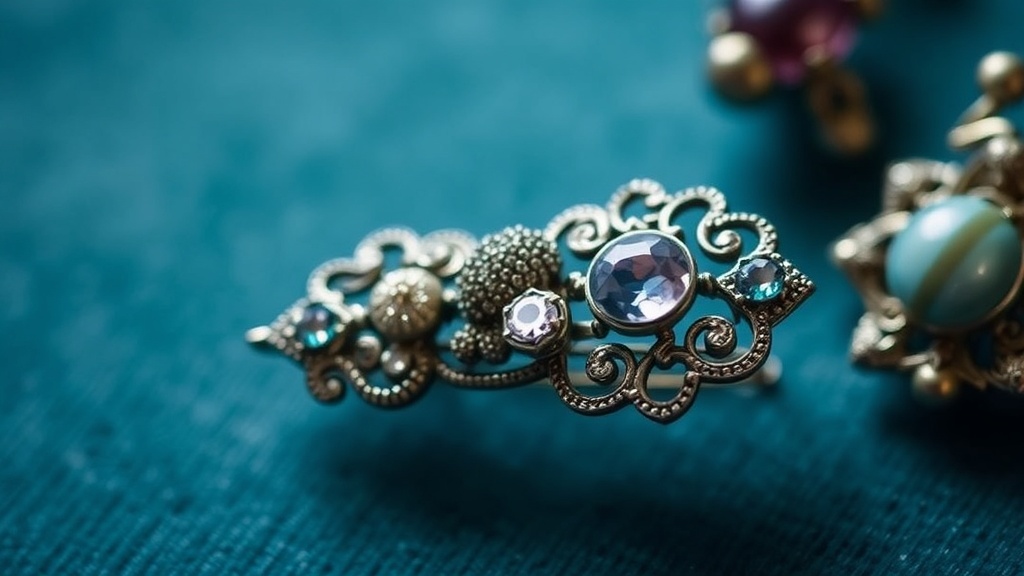
Dating Vintage Brooches: What the Clasp Tells You About Its Age

This post explains how to date vintage brooches by examining their clasps, hinges, and construction methods. You'll learn to spot the difference between a genuine Victorian c-clasp and a modern reproduction, recognize when a trombone clasp places a piece in the 1930s, and identify safety clasps that became standard after the 1950s. These physical details are far more reliable than vague seller descriptions — and they'll help you avoid costly mistakes when hunting for authentic vintage pieces.
What Does a C-Clasp Tell You About a Brooch's Age?
The humble c-clasp — named for its simple curved shape — dominated brooch construction from the 1890s through the 1930s. If you flip over a vintage brooch and see a simple pin mechanism that hooks into a curved metal catch without any rolling, locking, or safety features, you're looking at this early closure style.
Here's what separates authentic c-clasps from modern imitations: the pin extends well beyond the catch (sometimes by a quarter-inch or more), and the metal tends to be thicker and less refined than later mechanisms. Victorian examples often feature hand-filed pins with slight irregularities — a telltale sign of handcraftsmanship that machine-made reproductions can't replicate convincingly.
The placement matters too. On genuine c-clasp brooches from the 1900s-1920s, the clasp sits noticeably higher than the main body of the brooch. This creates a subtle tilt when worn — something collectors call "pin rise." Modern reproductions typically sit flat because manufacturers don't bother replicating this functional (if slightly awkward) design quirk.
Be wary of brooches described as "Victorian" that feature c-clasps combined with modern-looking construction. The c-clasp persisted into the 1930s, so its presence alone doesn't guarantee antique status. Look for accompanying details: hand-soldered joints, irregular stone settings, and the type of metal used all help confirm whether that c-clasp brooch is genuinely from the turn of the century or merely a 1930s piece with old-school construction.
When Did Trombone Clasps Become Popular?
Trombone clasps — named for their sliding tube mechanism that resembles the instrument — emerged in the 1930s and remained common through the 1950s. If you're examining a brooch with this distinctive slide-and-lock closure, you're likely looking at a piece from the Art Deco era through mid-century.
The mechanism works like this: a small metal tube slides along the pin shaft to lock it in place. It's clever, secure, and distinctly different from the simple hook of earlier decades. Vintage jewelry historians note that trombone clasps first appeared in European jewelry before crossing to American manufacturers around 1935.
What's particularly useful about trombone clasps is their association with higher-quality costume jewelry. Companies like Trifari, Coro, and Eisenberg frequently used these mechanisms in their better pieces during the 1940s and early 1950s. Finding a trombone clasp on an unsigned brooch doesn't guarantee a major designer piece, but it does suggest the maker invested in quality hardware — a good sign for collectors.
The trombone clasp fell out of favor by the late 1950s as simpler safety clasps became cheaper to manufacture. So if you're dating a brooch and spot this sliding mechanism, you've narrowed its window to roughly 1930-1960 — with the sweet spot being 1935-1955.
How Can You Recognize Safety Clasps and Their Era?
Safety clasps — the rotating or rolling closures that lock the pin in place — became the industry standard around 1950 and remain ubiquitous today. But not all safety clasps are created equal, and subtle differences help pinpoint when a brooch was actually made.
Early safety clasps from the 1950s and 1960s feature a simple spinning cylinder that rotates over the pin tip. These tend to be small, unobtrusive, and made from the same metal as the rest of the clasp mechanism. The rolling motion is smooth but sometimes slightly stiff — decades of oxidation can make them feel tighter than they originally were.
By the 1970s and 1980s, safety clasps grew larger and more pronounced. Costume jewelry manufacturers began using bigger, more visible mechanisms that were easier to operate (and cheaper to produce). These later clasps often feature a distinct "bump" or larger rotating piece that sits prominently above the brooch back.
Modern safety clasps — those from the 1990s onward — frequently include a spring mechanism or a simple pressure-fit closure rather than a true rotating lock. These feel different in your fingers: lighter, less substantial, and prone to wearing out with use. When you encounter a brooch described as "vintage" but it features a flimsy modern-style clasp, that's your cue to dig deeper into its actual provenance.
Hinges Tell Their Own Story
While clasps get most of the attention, the hinge mechanism connecting the pin to the brooch body offers additional dating clues. Early pieces (pre-1930) often feature tube hinges — a simple cylinder of metal that the pin passes through. These were hand-fabricated and show slight irregularities under magnification.
By the 1940s, many manufacturers switched to stamped hinges — flatter, more uniform pieces created through metal-stamping processes. These look crisper and more consistent than their hand-made predecessors. The transition wasn't absolute (some fine jewelry retained tube hinges much longer), but in costume jewelry, stamped hinges strongly suggest mid-century or later manufacture.
What About Mixed Signals?
Sometimes you'll encounter brooches that seem confused — a Victorian-style c-clasp paired with a 1950s-style hinge, for instance. These mixed signals usually indicate one of three scenarios: a genuine vintage piece that was repaired with newer parts, a "married" piece assembled from components of different eras, or a modern reproduction using mismatched hardware.
Repairs are common and not necessarily problematic for collectors — but you should know what you're buying. Examine the hinge and clasp areas for fresh solder, color differences in the metal, or tool marks suggesting recent work. An honest seller will disclose repairs; evasive answers about "unusual construction" should raise red flags.
Why Do These Details Matter for Collectors?
Understanding clasp evolution isn't just academic trivia — it directly affects value and authenticity. A genuine 1920s Art Deco brooch with its original c-clasp commands significantly more than a 1980s reproduction with similar styling. The hardware doesn't lie, even when the front of the piece has been carefully aged to look older than it is.
For dealers and collectors in the vintage jewelry market, clasp identification provides quick screening capability. When you're browsing a crowded estate sale or auction lot, flipping pieces to check their closures saves time and prevents expensive mistakes. That "Victorian" cameo with a 1970s-style safety clasp? Pass. The "mid-century" abstract brooch with a genuine trombone clasp? Worth a closer look.
The construction methods also reveal information about quality and manufacturing origin. European costume jewelry often used different clasp styles than American pieces during certain periods. French jewelry from the 1950s might feature distinctive clasp variations that help distinguish it from mass-produced American counterparts. These regional differences become apparent once you start examining hardware systematically.
Finally, there's the satisfaction of reading a piece's history through its physical details. When you can hold a brooch and recognize its c-clasp, hand-soldered hinge, and slightly irregular pin length, you're holding something made by human hands decades ago — not spit out by a modern production line. That connection to craftsmanship matters, especially in an era of disposable fashion.
Next time you're evaluating a vintage brooch, take the extra thirty seconds to examine its back. The clasp, hinge, and construction details will tell you more about its age and authenticity than any paper tag or seller's claim. With practice, these visual cues become second nature — and your collection will be stronger for the attention you've paid to what most people never bother to see.